Note
Click here to download the full example code
Hammersley vs Random
In this example we compare the tiling efficiency of just choosing random numbers for \(\theta\) and \(\phi\) tiling angles compared to using Hammersley Points
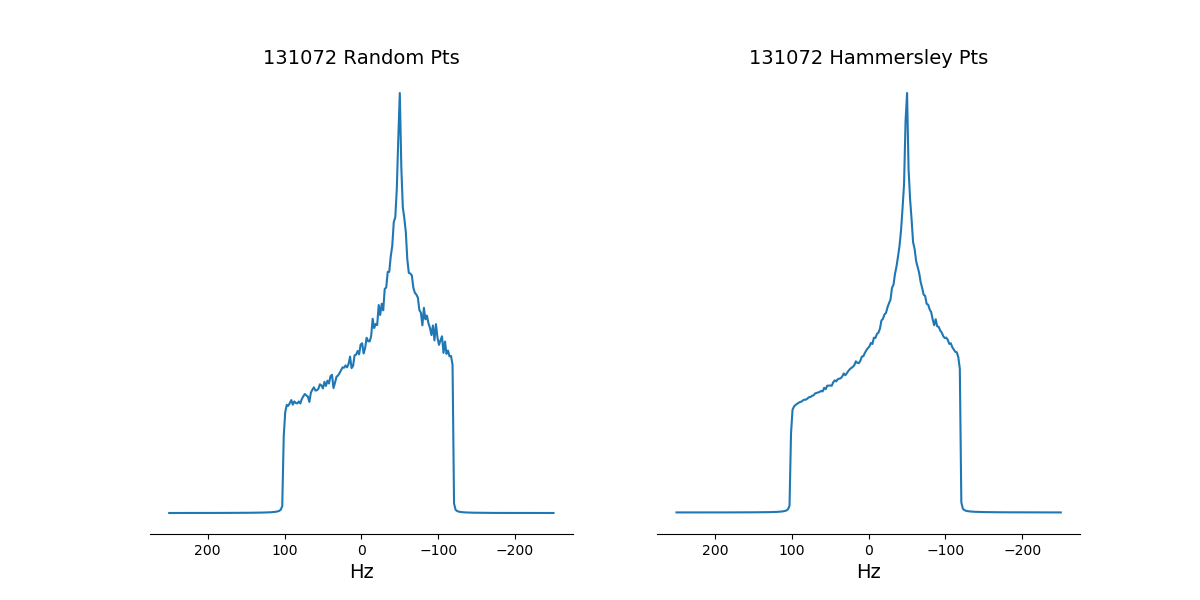
Out:
C:\Users\ERIC\Documents\pygamma_gallery\docsource\sphinx\examples\hammersleypoints\plot_csa_static_ham_rand.py:172: UserWarning: Matplotlib is currently using agg, which is a non-GUI backend, so cannot show the figure.
  plt.show()
import numpy as np
from scipy import fftpack
from matplotlib import pyplot as plt
import sys


def return_Hammersley_points_array( l, n, p):
    """
    l is the power of x to go out to p^m
    n is the maximun number of points
    p is the order of the Hammersley point, 1,2,3,4,... etc

    returns
    --------
    np.array of double

    """

    vvv = np.zeros(n)

    for m in range(n):
        m1=1*m
        if p == 1:
            vvv[m] =  m1/n
        else:
            v = 0.0

            for j in range(l,-1,-1):
                num = m1//p**j

                if num > 0:
                    m1 -= num*p**j
                    v  += num / ( p ** (j+1) )

            vvv[m]=v

    return(vvv)


def omega_cs( theta, phi, iso_cs=0.0, asymm_cs=100, eta_cs=1.0):

    return (iso_cs +0.5* asymm_cs*(3.0 * (np.cos(theta)**2) -1.0 - eta_cs*(np.sin(theta)**2)*np.cos( 2.0 * phi ))), np.sin(theta)

if __name__ == "__main__":

    # Define CSA powder pattern

    # Principal components of the chemical shift shielding tensor

    s_zz = -120.0
    s_yy = -50.0
    s_xx =  100.0

    ncols = 256
    nrows = 256

    sw = 500.0
    dt = 1/sw
    time_axis = np.arange(ncols)*dt
    lb = 2.0
    axis_Hz = np.linspace( -sw/2., sw/2., ncols )

    # Check for Haeberlens convention

    iso_cs =(s_zz+s_yy+s_xx)/3.

    if abs(s_zz-iso_cs) >= abs(s_xx-iso_cs) and abs(s_xx-iso_cs) >= abs(s_yy-iso_cs):
        h_zz = s_zz
        h_yy = s_yy
        h_xx = s_xx

    elif abs(s_zz-iso_cs) < abs(s_xx-iso_cs) and abs(s_xx-iso_cs) >= abs(s_yy-iso_cs):
        h_zz = s_xx
        h_yy = s_yy
        h_xx = s_zz

    else:
        print("problem with assignment of cs tensors")
        sys.exit()

    asymm_cs = h_zz-iso_cs
    eta_cs   = (h_xx-h_yy)/(h_zz-iso_cs)

    # Calculate Hammersley Points and Powder pattern
    N_particles = 2**17

    theta = return_Hammersley_points_array(22, N_particles, 2)
    phi   = return_Hammersley_points_array(22, N_particles, 3)

    omega_ham, solid_angle_ham = omega_cs(theta*np.pi,2*np.pi*phi, eta_cs=eta_cs, iso_cs=iso_cs, asymm_cs=asymm_cs)

    # Calculate random Points

    pts = np.random.rand(2,N_particles)

    theta = pts[0]*np.pi
    phi   = pts[1]*2.0*np.pi

    omega_rand, solid_angle_rand = omega_cs( pts[0]*np.pi,pts[1]*2.0*np.pi, eta_cs=eta_cs, iso_cs=iso_cs, asymm_cs=asymm_cs)

    # Propogate FID

    ccc_rand = np.cos( np.outer( 2*np.pi*omega_rand, time_axis ))
    sss_rand = np.sin( np.outer( 2*np.pi*omega_rand, time_axis ))

    ccc_ham = np.cos( np.outer( 2*np.pi*omega_ham, time_axis ))
    sss_ham = np.sin( np.outer( 2*np.pi*omega_ham, time_axis ))

    ## Apply solid angle weighting

    ccc_rand =  solid_angle_rand.reshape((N_particles,1)) *ccc_rand
    sss_rand =  solid_angle_rand.reshape((N_particles,1)) *sss_rand

    ccc_rand = ccc_rand.sum( axis=0)
    sss_rand = sss_rand.sum( axis=0)

    ccc_ham =  solid_angle_ham.reshape((N_particles,1)) *ccc_ham
    sss_ham =  solid_angle_ham.reshape((N_particles,1)) *sss_ham

    ccc_ham = ccc_ham.sum( axis=0)
    sss_ham = sss_ham.sum( axis=0)

    # create complex array, apply exponential linebroadeining, FFT

    fid_rand = ccc_rand*np.exp(-lb*time_axis) + 1J * sss_rand*np.exp(-lb*time_axis)
    spec_rand = fftpack.fft(fid_rand)
    spec_rand = fftpack.fftshift(spec_rand)

    fid_ham = ccc_ham*np.exp(-lb*time_axis) + 1J * sss_ham*np.exp(-lb*time_axis)
    spec_ham = fftpack.fft(fid_ham)
    spec_ham = fftpack.fftshift(spec_ham)


    # display Spectra side by side

    fig, axs = plt.subplots(1, 2, figsize=(12, 6), sharey=True)

    ax = axs.flatten()

    ax[0].plot(axis_Hz,(spec_rand.real/(spec_rand.real).max())  );
    ax[1].plot(axis_Hz,(spec_ham.real/(spec_ham.real).max())  );
    l,r = ax[0].get_xlim()
    ax[0].set_xlim(r,l)
    ax[1].set_xlim(r,l)

    ax[0].spines['top'].set_visible(False)
    ax[0].spines['left'].set_visible(False)
    ax[0].spines['right'].set_visible(False)

    ax[1].spines['top'].set_visible(False)
    ax[1].spines['left'].set_visible(False)
    ax[1].spines['right'].set_visible(False)

    ax[0].set_yticks([])
    ax[1].set_yticks([])

    ax[0].set_xlabel( 'Hz', fontsize=14 )
    ax[1].set_xlabel( 'Hz', fontsize=14 )

    ax[0].set_title(str(N_particles) +" Random Pts", fontsize=14)
    ax[1].set_title(str(N_particles) +" Hammersley Pts", fontsize=14)

    plt.show()
Total running time of the script: ( 0 minutes 5.205 seconds)